Every practice has an origin story. Here's ours — where Echo Restore actually came from,…
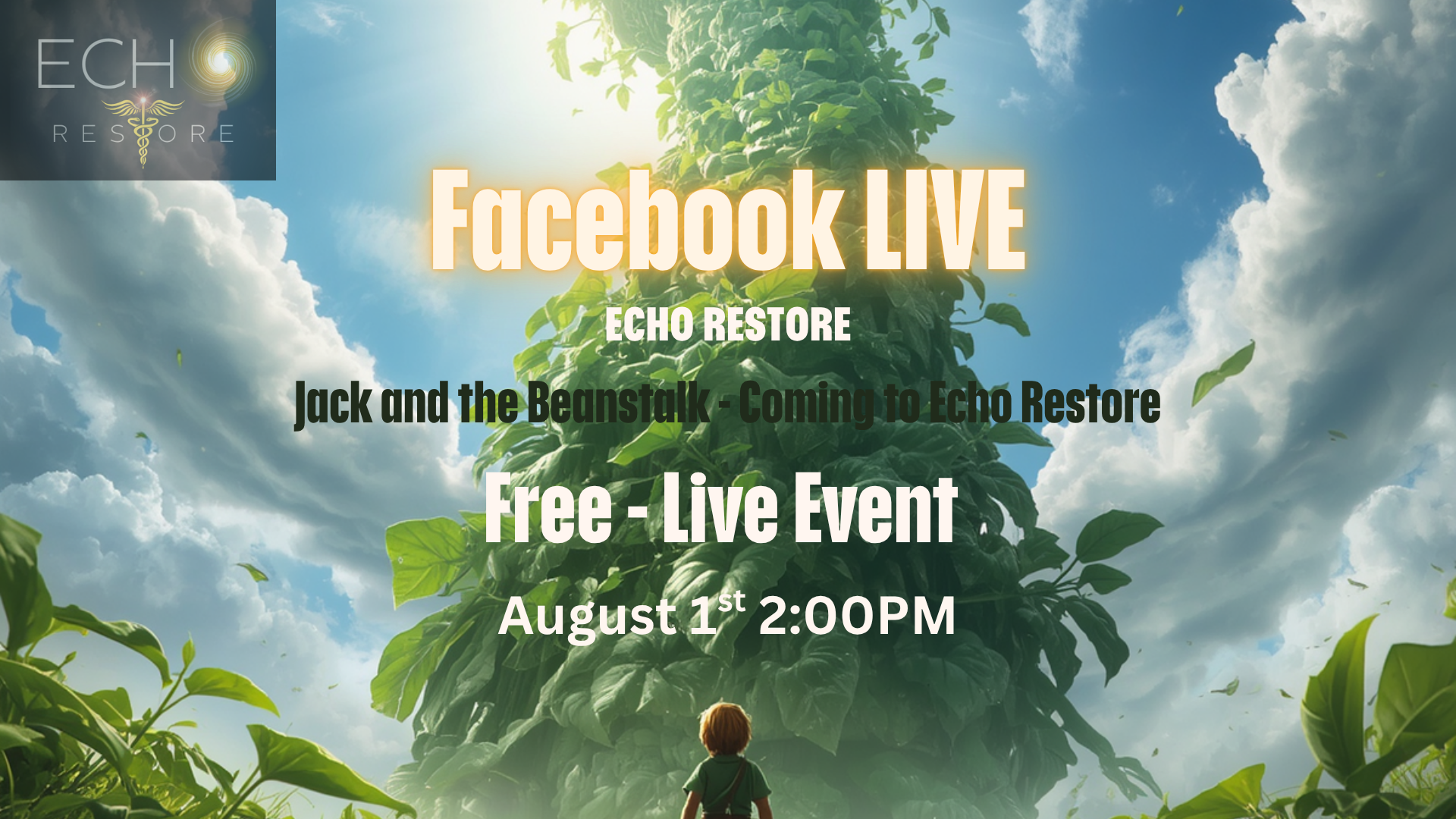
The Hidden Lesson in Jack and the Beanstalk: What This Story Really Teaches Us About Sacrifice, Letting Go, and the Mind-Body Connection
Most of us know Jack and the Beanstalk as a children’s story — a boy, some magic beans, a giant, a harp. But in our recent live session, we took a different look at it. Not as a fairy tale, but as an analogy for something much deeper: the sacrifices we make, and the connection between our mind and body that we so rarely stop to notice.
Here’s what we uncovered.
Sacrifice isn’t loss — it’s an unlock
Early in the story, Jack is struggling. He’s failing his class, he’s not doing well, and it’s the mayor who introduces him to the idea of sacrifice — something precious to you that you give up, even when you don’t know how or why. Jack ends up trading his most prized possession, his video game, for a handful of beans. He doesn’t know they’re magical. He just knows he’s giving up something that matters to him.
That’s the point. A real sacrifice isn’t a trade you make because you can see the payoff coming. It’s giving up something valuable without knowing what’s on the other side — because the reward is often something your current mind can’t yet comprehend. You only find out what you’ve unlocked after you’ve let go.
Climbing is supposed to feel hard
When Jack starts climbing the beanstalk, he notices how much harder it is than he expected. That’s normal. Growth isn’t supposed to feel effortless — the discomfort in between is part of what makes the process real. We talked about how so much of modern life is built around choosing when to feel good — scrolling, screens, distractions, even substances — instead of sitting with the harder, in-between feelings that are actually doing the work of moving us forward.
The absent father, the untrustworthy guide, and what they represent
Jack doesn’t have his father around, yet some part of him still knows how to look for direction, safety, and protection — because that’s a natural part of human development. Later in the story, he meets a girl who turns out to be using him. When the truth finally comes out between them in the jail cell, something shifts: he lets himself be vulnerable. He grieves the father he missed. And right after that release, a key appears — the very thing he needed to get free.
That sequence isn’t an accident. Vulnerability and honesty are very often the doorway to the breakthrough we’ve been looking for. The things we’re most guarded about are usually exactly what need to be faced.
Cutting down the beanstalk
When the beanstalk finally comes down, the ground shakes and everyone around Jack panics. That’s what it can feel like when you cut away a pattern or a part of your identity that’s been there for years, even decades. People around you can sense the shift. It can feel disorienting. But that reaction is your body doing exactly what it’s supposed to do — adjusting, recalibrating, finding a new alignment.
Interestingly, in the story, it’s the townspeople — out of fear — who try to chop the beanstalk down too early, before Jack has finished what he came to do. That’s worth sitting with: the people around us, often with good intentions, can pressure us toward a “quick fix” instead of letting a real process complete. True change can’t be rushed just because it makes other people uncomfortable.
The reward is always bigger than what you gave up
By the end, Jack walks away with more than he could have imagined when he first handed over that video game — treasure, a goose that lays golden eggs, a harp. The lesson here isn’t about the objects. It’s that when we let go of what we think we can’t live without, what we get back is almost always bigger than what we gave up — because we couldn’t have imagined it from where we were standing before.
Why this story, and why now
Stories like this stick with us for a reason. They tap into something we recognize on a subconscious level — sacrifice, resilience, letting go, and the discomfort of growth — even if we can’t always articulate why. That’s exactly the work we do at Echo Restore: helping people identify the “beanstalks” in their own lives — the patterns, beliefs, and structures that have been there so long they start to feel like reality — and guiding them through the process of letting go, so they can reconnect with a deeper, more aligned version of themselves.
Missed the live session? You can watch the full replay here: Jack and the Beanstalk — Full Replay
Want to go deeper? Learn more about our group events and meditation programs at EchoRestore.com.

Related Posts